

Every home, every company, one clear view.
Twenty homes across three companies is a business, with a business's paperwork: loans, certificates, contractors, staff and tax for each entity. We build portfolio landlords one system that brings every home and every company together, so you can see what needs doing across the whole portfolio at once.

A portfolio is a business. The admin grows with it.
Most portfolio landlords we speak to built their business carefully, one purchase at a time. The systems grew the same way, one spreadsheet, folder and inbox at a time, and now they are doing more work than they should.
Homes spread across entities
Homes held personally and in one or more limited companies, each with its own bank account, lender and accountant. Seeing the whole picture means opening every file.
Loans and renewals
Fixed-rate end dates, insurance renewals and licence expiries spread across lenders and councils, each one costly if it slips past.
Contractors and upgrades
Repairs, refurbishments and energy upgrades across many homes, with quotes, invoices and sign-offs scattered across email and messages.
Knowledge in one head
When a property manager, bookkeeper or family member helps run the portfolio, everything depends on them knowing which folder holds what.
What we build for portfolios.
Start with the part that costs you most time. Everything shares one set of records, so a home, a tenancy or a certificate is entered once and used everywhere.
Money by home, by company, by quarter.
Rent in, costs out and receipts attached, kept per company and per home. Your accountant gets clean records, and homes held in your own name are ready for the quarterly updates of Making Tax Digital if they apply to you.
Homes, loans and rent grouped by company or held personally, with the totals that matter to you.
Photograph an invoice and it is read, matched to the right home and filed for your accountant to check.
Fixed-rate end dates and valuation dates tracked against each home, with a reminder well ahead.
Energy ratings, quotes and planned works logged against each home, so improvement spending is planned year by year.
The rules that shape a portfolio now.
Tenancy reform, a national landlord register, energy standards and digital tax records all land on every home you own. Here is what matters across a portfolio, and where software takes the strain.
Renters' Rights Act: the new tenancy system
Most private tenancies in England became assured periodic tenancies with no fixed end date, new and existing alike. Section 21 no-fault evictions ended, possession now uses section 8 grounds and Form 3A, and new tenants must get the key terms in writing.
Source: GOV.UK, Renters' Rights Act: an overview for landlords
Private Rented Sector Database
Landlords will register themselves and every let home, with gas, electrical and energy certificate evidence. Regions are planned to open in turn, from the West Midlands on 15 December 2026, with London from 15 July to 14 October 2027. The regulations still need Parliament's approval, and the government's planned fee is £65 per property per year. The landlord starts each registration, and an appointed letting agent can supply the property details.
Minimum energy ratings
Rented homes in England and Wales must be EPC band E or better unless an exemption is registered. The government has decided to raise this to band C for all tenancies by 1 October 2030, with a £10,000 cost cap per property, but the regulations are not yet law.
Source: GOV.UK, Improving the energy performance of privately rented homes: government response
Making Tax Digital for Income Tax
Landlords with qualifying income over £50,000 must keep digital records and send quarterly updates from compatible software. The threshold falls to £30,000 from April 2027 and £20,000 from April 2028. Updates are due on 7 August, 7 November, 7 February and 7 May.
Source: HMRC, Find out if and when you need to use Making Tax Digital for Income Tax
New tax rates for property income
Property income will have its own rates of 22%, 42% and 47% from 6 April 2027, and mortgage interest relief will be given at 22%. Scotland and Wales can set their own rates. Checked before the Budget on 28 October 2026.
Source: HMRC, Change to tax rates for property, savings and dividend income
Stamp duty surcharge on additional homes
Buying an additional home in England or Northern Ireland means stamp duty at 5 percentage points above the standard rates. Wales and Scotland have their own taxes and surcharges.
Source: HMRC, SDLT: buying an additional residential property
Additional and selective licensing
Councils can license smaller HMOs, or every privately rented home in an area. Since 23 December 2024 they no longer need government approval to do so, after a 10-week consultation.
Gas every year, electrics every five
A Gas Safe registered engineer must check gas appliances every 12 months, with the record to tenants within 28 days. Electrical installations must be inspected at least every five years, with reports to tenants within 28 days and fines of up to £40,000.
Source: legislation.gov.uk, Electrical Safety Standards Regulations 2020, reg 3
A Landlord Ombudsman for every private landlord
All private landlords will have to join a new ombudsman that settles tenants' complaints with binding decisions, including compensation. Membership is expected to become compulsory in 2028, with notice beforehand.
Source: MHCLG, Implementing the Renters' Rights Act 2025: roadmap
A summary to show where software helps, not legal advice. Dates and figures checked against the sources shown on 23 October 2026.
From buying a home to the year end.
Follow one home through the portfolio. Each step leaves a record your team, your lender and your accountant can rely on.
Deal figures, purchase costs and the company it sits in, recorded from day one.
Certificates, licences and refurbishment tracked until the home is ready to let.
The rent advertised, the tenancy agreed and every document sent and logged.
Repairs, inspections and certificate renewals handled by your team and trades, all on record.
Fixed-rate end dates and valuations flagged in time to plan the next loan.
Rent, costs and upgrades by home and by company, ready for your accountant and your lender.
Property work that is live today.
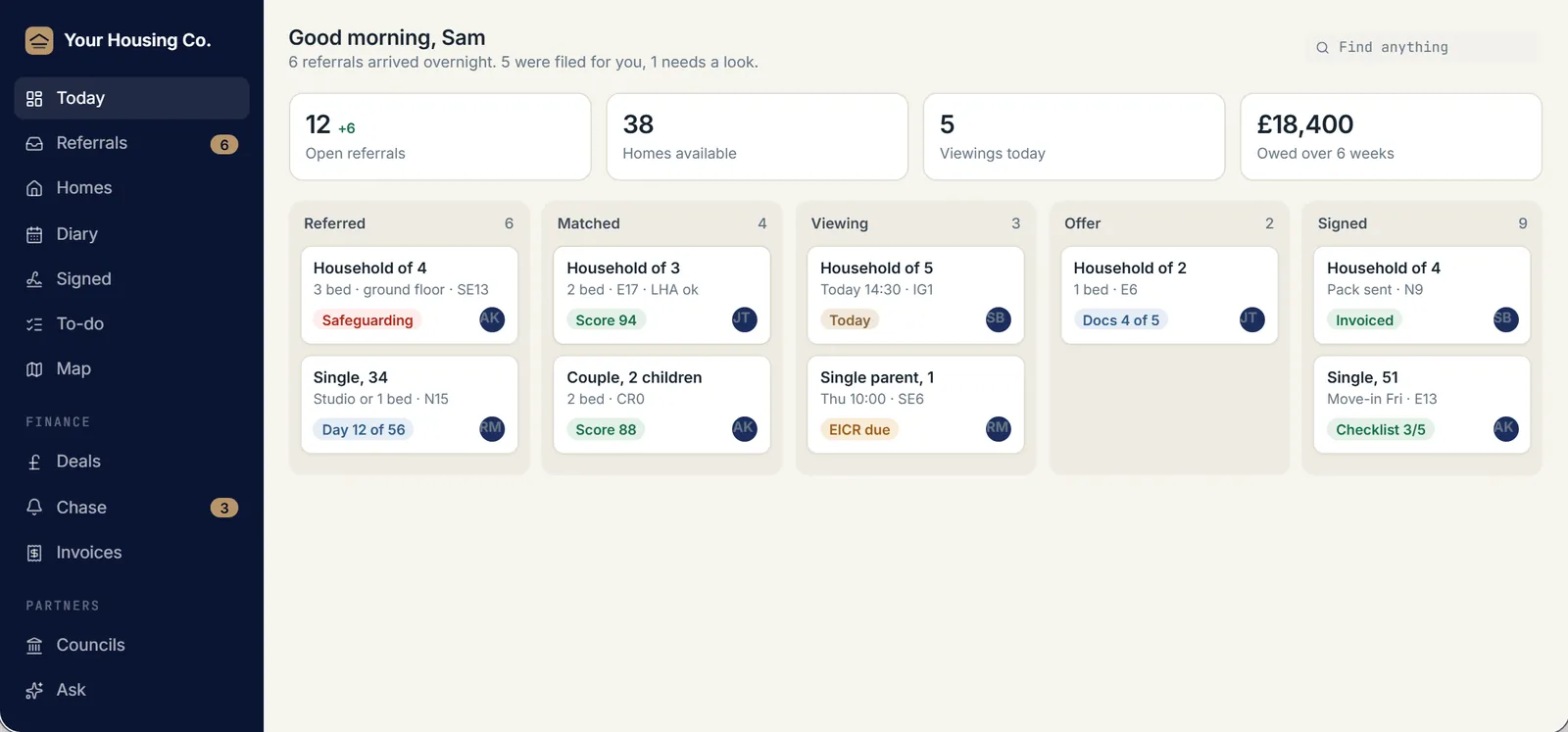
Real websites and systems in use by UK property businesses.
Questions portfolio landlords ask us.
Anything else, ask us on the call.
Can it handle homes in more than one company?
Will it help with Making Tax Digital?
Can our property manager and bookkeeper have their own logins?
We have years of records in spreadsheets. Do we start again?
Can it help us plan energy upgrades?
Does it connect to our bank and accounting software?
Is our data, and our tenants' data, safe?
Keep reading
Tell us how you work today.
A short call, your screen and ours. We listen to how your week runs, show you what we would build, and give you a fixed price in writing.
- Built around your process, not a template
- Hosted, looked after and improved by us
- One UK studio from first call to launch
Prefer email? semir@bozmaps.com